
The System Responds, But Nothing Changes
Why interaction quietly dies

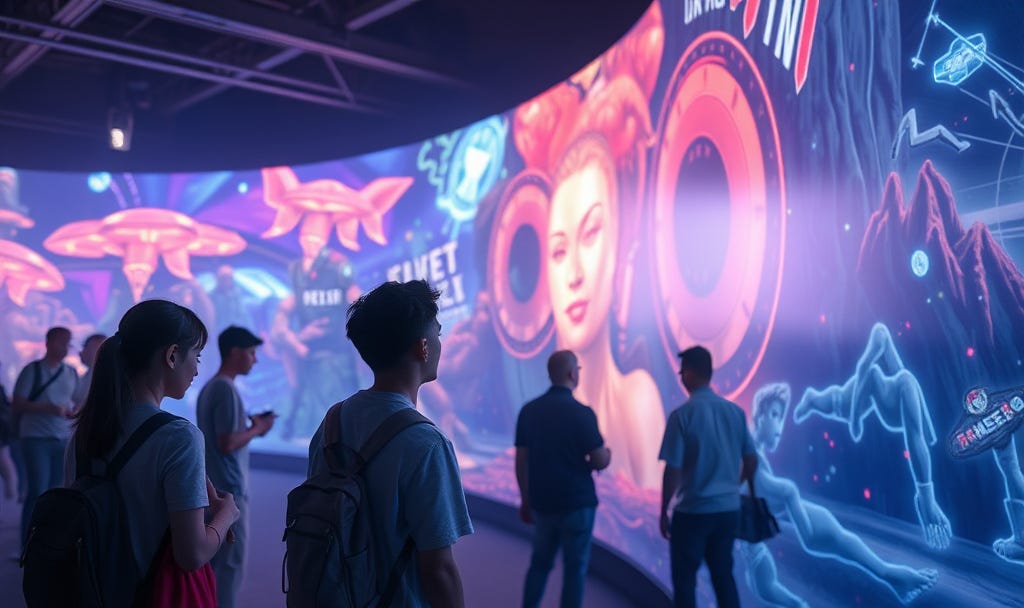
You’ve probably done this.
You walk into something that’s supposed to be interactive—an installation, a projection room, a space where the effects move when you move.
At first, it’s immediate.
You step forward and the floor shifts under you. You raise your hand and something follows it across the wall. You turn, and the environment turns with you.
It works. So you do it again.
The Second Moment
This time, you’re paying attention.
You move slower. You repeat the same motion. You try to see if the system will respond differently—if there’s more to it than what you just saw.
And it does respond. But not differently.
Just… again.
The Third
You try one more time.
A variation. A pause. Something intentional.
Because even if you’re not thinking it explicitly, there’s a quiet assumption:
If this is interactive, there should be somewhere to go with it.
And this is where it slips.
The system reacts—but nothing deepens.
No matter what you do, it stays within the same range. Same patterns. Same outcomes.
You’re not discovering anything new. You’re just triggering it again.
What You Do Next
You don’t analyze it.
You don’t think, this system lacks persistence.
You just… stop.
You look around. You move on. You give it less of your attention.
Because you’ve already learned what it can do.
And what it can’t.
The Anchor
And this is the moment it becomes clear:
You’re not shaping the system. You’re just re-triggering it.
It responds in real time—but nothing you do carries forward.
Which means:
There’s nowhere to go.
Why That Matters
This isn’t about expectations.
No one walks in thinking, I should be able to change the system.
But people can feel when their actions don’t lead anywhere.
Interaction only continues if there’s a sense of expansion—of possibility.
The moment everything loops back on itself, engagement ends.
Quietly.
Zooming Out
You see the same pattern beyond physical spaces.
Systems that respond immediately—but don’t evolve.
Experiences that feel dynamic—but stay fundamentally the same.
Interactions that work—once, twice, maybe three times—before they flatten out.
Not because they fail.
Because they’ve been learned.
The Actual Constraint
It’s not a question of better technology.
It’s not speed.
It’s not intelligence.
It’s this:
Nothing you do changes what happens next.
So nothing accumulates.
And without accumulation, there’s no reason to keep going.
Closing
Most systems don’t lose people because they break.
They lose them the moment there’s nothing left to discover. And that moment comes faster than we think.
So I went looking for what was missing underneath.